
Why You’re Not Getting Stronger (The Real Reasons Lifters Plateau)
Dec 04, 2025If you’re training consistently but not getting stronger, you’re not alone and you’re not broken. Strength is extremely predictable when you follow the fundamentals. Most plateaus come from a handful of issues that stop the body from adapting.
This blog breaks down the real reasons you're not getting stronger—and what to do about each one—based on current strength science, performance research, and what actually works in the gym.
Let’s fix your plateau.
1. Your Warm Up Isn’t Setting You Up for Strength
A proper warm up directly increases force output. Studies consistently show a 2-5% improvement in strength performance when muscle temperature, joint readiness, and neural activation are properly primed.
The problem is:
Most people either walk into their first heavy set cold… or they do 15 minutes of random mobility that never prepares the actual pattern they’re about to load.
A good warmup is short, specific, and intentional.
What to do:
-
Pick 1-2 mobility drills that target the joints you're about to use.
-
Then do 2-3 progressive ramp up sets of your main lift.
-
Increase load gradually until you reach your working weight.
Warm up for the lift, not for entertainment.
2. You’re Not Progressing Anything
If your body doesn’t see an increased stimulus over time, it has no reason to get stronger. This is the basic principle behind progressive overload—and no, it’s not outdated. It’s biology.
You do not need to max out. You do not need to crush yourself every session. You do need a measurable way to increase demand across weeks.
Ways to progress:
-
Add 2-5 pounds
-
Add 1-2 reps
-
Add a top set
-
Slow down your tempo
-
Improve your technique while keeping load the same
-
Increase density (same work, less time or less rest)
Progress happens from accumulating small, repeatable improvements... not one heroic workout.
View this post on Instagram
3. Your Training Is Too Random
Strength is specific. Your nervous system gets stronger by practicing the same movement patterns repeatedly.
When you change workouts constantly, you interrupt adaptation before it even begins. Novelty feels fun, but it prevents the consistent exposure required for strength gains.
This doesn’t mean your training needs to be boring—just structured.
What to do:
Choose your main lifts and run them for 4-8 weeks.
Accessories can rotate.
Foundational patterns probably shouldn’t as much.
Think: squat, hinge, lunge, push, pull. Hard, heavy, compound movements. Build your training block around these.
4. Your Reps Aren’t Consistent
This is one of the biggest, most silent killers of strength progress.
Strength is a motor skill. Your body improves force output by refining the movement pattern. If every rep looks different—different bar path, different depth, different tempo—your nervous system can’t learn anything.
Inconsistent reps = inconsistent results.
What to do:
Dial in technical consistency:
-
Same setup
-
Same bar path
-
Same tempo
-
Same breathing
-
Same depth or range of motion
When your reps become nearly identical, your strength increases predictably.
5. You’re Not Sleeping Enough to Recover
Strength is built in recovery, not necessarily during the workout.
Sleep is where:
-
Motor learning consolidates
-
Hormones regulate
-
Tissue repairs
-
The nervous system resets
Even one night of poor sleep reduces power, strength, and coordination. Chronic low sleep guarantees slower (or no) progress and higher injury risk.
What to do:
Set a non-negotiable sleep window.
Aim for 7-9 hours.
Dark, cold, quiet room.
Limit screens before bed.
Gym effort means nothing if recovery is not happening.
6. You’re Not Eating Enough Protein
Your muscles cannot grow or maintain strength without enough amino acids to repair tissue. Low protein intake is one of the most common issues among people who train consistently yet stay stuck.
Strength requires muscle. Muscle requires protein. This is not controversial in modern research.
What to do:
Aim for 0.7-1.0g of protein per pound of ideal bodyweight per day.
Hit 25-40g per meal.
Prioritize whole food protein sources first.
If you want to feel stronger, recover faster, and train harder… this matters.
Putting It All Together: The Strength Blueprint
If you want real, measurable strength gains, simplify your approach. Focus on these fundamentals...
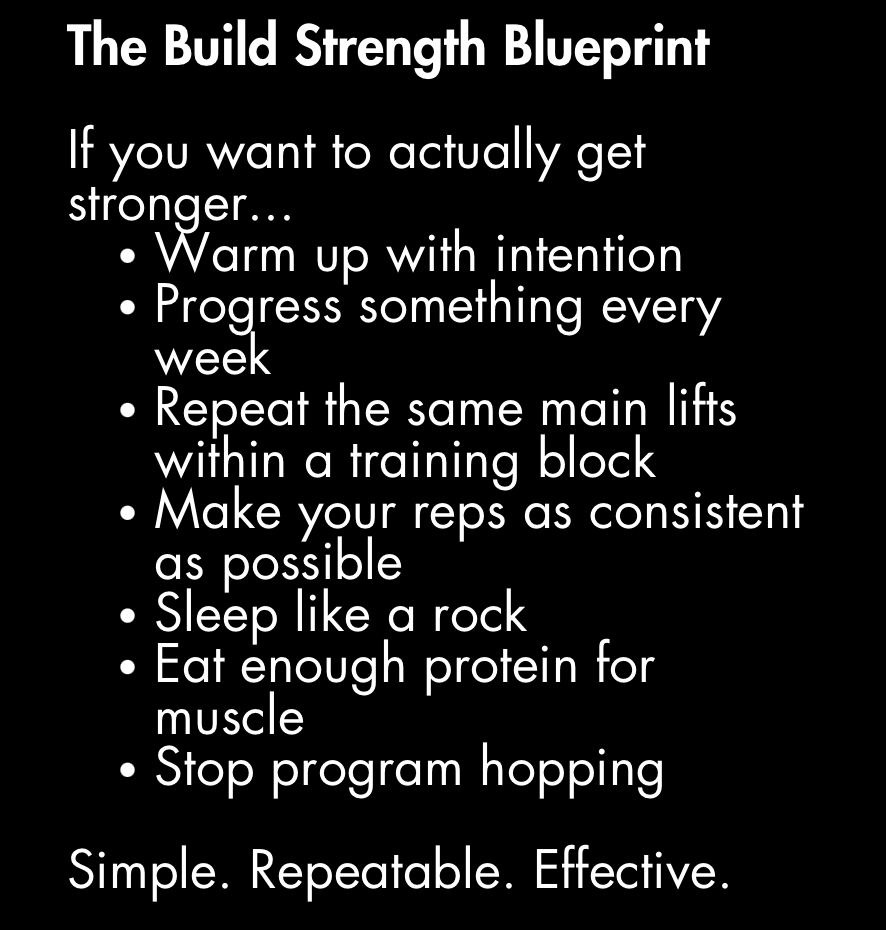
Strength isn’t built on chaos. It’s built on structure, repetition, and recovery.
If you want help building a strength program that actually works—whether you train at home or in a gym—I can help. Reach out anytime or explore my training programs for structured, no BS strength progression.
Want structured, purposeful, and time efficient workouts every day?
Join the team by clicking below!