
Heart Rate Recovery: Why It Matters for Performance, Strength, and Everyday Life
Oct 30, 2026One of the things I pay attention to when training is how quickly my heart rate comes back down after a hard effort.
This is called heart rate recovery (HRR), and it's a useful indicator of cardiovascular fitness and how your body responds to exercise.
Essentially, it's how much your heart rate drops after you stop exercising. Generally speaking, a faster drop is a good sign.
I've put a lot of emphasis on improving my aerobic fitness over the years, not just because I want to be a better runner, but because of how much it can impact everything else I do in and outside of the gym.
And heart rate recovery is one of the ways I can see those adaptations happening.
An Example From My Own Training
During a recent workout, I ran 4 x 1 mile repeats, increasing my perceived effort from 60% to 90%, with 3 minutes of rest between each mile.
Here's what my Garmin (I wear a chest strap) recorded:
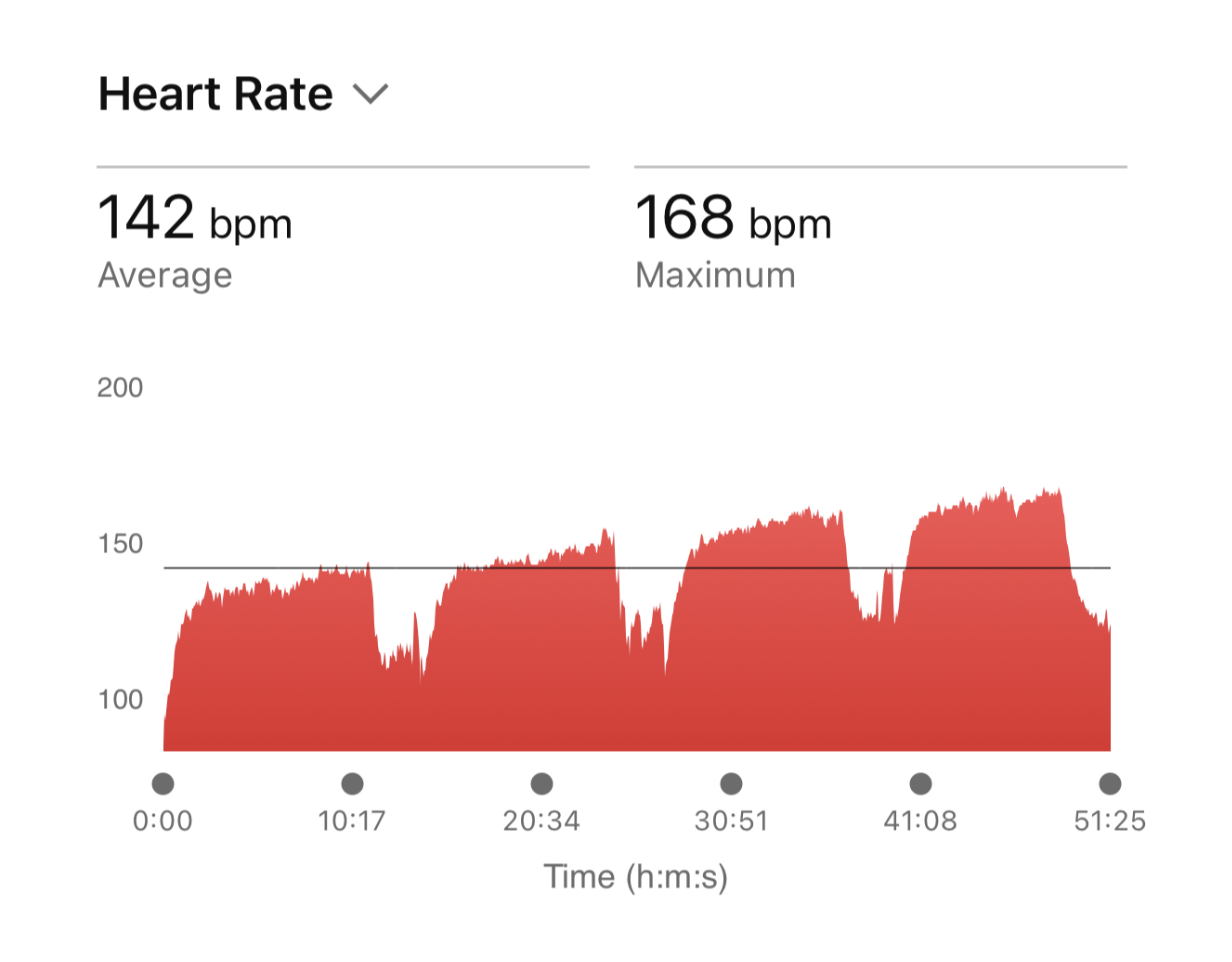
You'll notice two things in this screenshot:
-
My heart rate climbs higher with each mile as my effort increases, reaching about 170 BPM on the final repeat. Exactly as intended. Big thumbs up. 👍🏼
-
During each 3 minute recovery period, my heart rate drops back into the 120s, allowing me to recover before the next effort. Double thumbs up. 👍🏼👍🏼
The goal of this workout was to progressively increase my effort while maintaining enough recovery between intervals to keep the quality of each run high.
Being able to recover between those efforts is an important part of the equation.
How Is Heart Rate Recovery Measured?
The most common approach is to measure how many beats per minute your heart rate drops in the first minute after exercise.
For example, let's say you finish a hard effort and your heart rate is 170 BPM.
After one minute of recovery, it's down to 140 BPM.
Your one minute HRR is 30 BPM.
Pretty simple.
Some testing protocols also look at the drop after two minutes. Whether you're standing still, sitting, or walking during recovery matters, so measurements should be taken under consistent conditions.
My Garmin screenshot obviously isn't a standardized HRR test since we're looking at three minute recovery periods rather than measuring the exact drop after one minute.
But you can still get a pretty good idea of how my heart rate responds to repeated efforts and how quickly it settles down between them.
And if you have a Garmin, Apple Watch, or another device that tracks heart rate, you can start paying attention to this during your own workouts.
Why Does Heart Rate Recovery Matter?
Your ability to recover between hard efforts has a direct impact on how much quality work you can perform.
Think about a hard set of squats, a conditioning workout, or running intervals like the ones I just described.
You perform an effort, recover, and then do it again.
Better cardiovascular fitness can help you recover between those efforts, manage fatigue, and maintain your performance throughout a workout.
The better you can recover, the more quality work you may be able to perform. And more quality work, when programmed appropriately, can lead to better training adaptations and results over time.
This is one of the reasons aerobic fitness matters even if your primary goal is building strength or muscle.
Now, having a faster HRR doesn't automatically mean you're going to build more muscle or get stronger. It's an indicator of cardiovascular function, not a direct measurement of muscular recovery.
But improving your aerobic fitness can absolutely support your ability to perform more quality work in the gym.
And that's worth paying attention to.
Why I Put So Much Emphasis on Aerobic Fitness
I've spent more than a decade lifting weights, and strength training is still a huge part of what I do. My approach to fitness has evolved quite a bit over the years, as it should IMO.
I'm not interested in being really strong but getting winded every time I have to do something physically demanding for more than a few minutes. I want to be strong, have good endurance, recover well, and be able to handle whatever physical challenges come my way.
That's also how I approach programming for the people I coach.
Even when someone's primary goal is building muscle or getting stronger, I still want them doing some form of aerobic training.
Let's say you're performing several challenging sets of squats. Your muscles are working hard, your breathing is elevated, and your heart rate is climbing.
Between sets, your body needs time to recover before you can produce another quality effort.
If your cardiovascular fitness is poor, you might find yourself struggling to catch your breath or feeling generally exhausted before you're ready to go again.
Having a better developed aerobic system can help you manage those demands and maintain the quality of your training.
It doesn't replace the need for adequate rest between sets, but it can make a difference in how well you tolerate the work you're doing.
Your aerobic fitness supports your strength training. They aren't two completely separate things.
Outside the Gym
It's not just training that's impacted.
A well conditioned cardiovascular system helps you handle the physical demands of everyday life, whether that's climbing stairs, carrying heavy things, working outside, hiking, or simply staying active for long periods without getting wiped out.
Think about how much easier those things become when you have significantly more physical capacity than your daily life requires.
You can do more without feeling like every physical task is a workout.
And when something more demanding comes along, you've got the capacity to handle it.
That's a big part of why I train the way I do, and why I encourage my clients to develop more than just strength.
I want my training to support the rest of my life, not just what happens inside the gym.
How Do You Improve Heart Rate Recovery?
Consistent aerobic training, including easier sustained efforts and appropriately programmed higher intensity work, can improve cardiovascular fitness and heart rate recovery over time.
You do not have to be a runner to benefit.
Walking, cycling, rowing, swimming, jogging, and plenty of other activities can help improve your aerobic fitness.
I generally like to see people develop a combination of two things:
1. An aerobic base.
This is your easier, sustained aerobic work. The kind of effort you can maintain for a longer period without completely exhausting yourself.
It might be a 30 to 45 minute bike ride, a steady row, a jog, or a brisk walk, depending on your current fitness level.
The goal is to consistently accumulate time doing aerobic work.
2. Some higher intensity training.
This is where intervals, harder conditioning efforts, and other appropriately programmed challenges come into play.
These sessions place a greater demand on your cardiovascular system and can help improve your ability to perform and recover from harder efforts.
You don't need to hammer yourself every time you train, though. In fact, most people would benefit from doing more easy aerobic work rather than making every cardio session as hard as possible.
Both types of training have their place.
And like anything else in fitness, consistency matters more than the occasional really hard workout.
Should You Track Your HRR?
I think it's worth paying attention to, especially if you already wear a device that tracks your heart rate.
No need to obsess over it or turn every workout into a test. But occasionally looking at how quickly your heart rate comes down after a challenging effort can give you some very useful information.
If you want to measure it more consistently, record your heart rate immediately after an effort and again after 60 seconds of recovery.
Subtract the second number from the first, and there's your one minute HRR.
Just make sure you're comparing similar efforts and using the same recovery method each time.
One thing worth mentioning is that HRR is influenced by exercise intensity, recovery activity, temperature, hydration, fatigue, and other factors, too.
So don't get too caught up comparing your numbers to someone else's or drawing conclusions from one data set from one workout.
Pay attention to your own trends under similar conditions.
Are you recovering faster after comparable efforts? Can you sustain a faster pace at the same heart rate? Are you able to perform more work without getting as fatigued?
Those are all things worth considering.
So...
Heart rate recovery is just one piece of the fitness puzzle, but it's a useful one.
Improving your aerobic fitness can help you recover between hard efforts, maintain your performance throughout workouts, and handle more physical work without getting completely wiped out.
And those benefits carry over into everyday life.
This is why I continue to prioritize aerobic training alongside strength training, both for myself and for the people I coach.
I don't think you need to be exceptional at any one physical quality to be healthy and capable. But I do think there's a lot of value in developing a well rounded body that can handle a variety of demands.
Being fit isn't just about how much work you can do once. It's also about how well you can recover and do it again.
Want structured, purposeful, and time efficient workouts every day?
Join the team by clicking below!